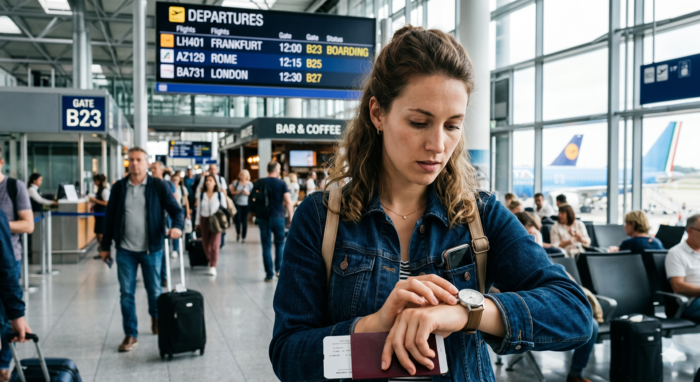
How Early Should You Get to the Airport? A Practical Guide by Flight Type
21 avril 2026
Some travellers arrive at the airport three hours early, coffee in hand, ready to browse the duty-free at leisure, while others are still frantically checking their pockets for their passport while joining the back of a very long queue.
Regardless of which one is you, if you've ever wondered how early you should get to the airport, you're not alone as it's one of the most common travel dilemmas, and the honest answer is: it depends.
In this guide, you'll find recommended airport arrival times for every flight type, check-in deadlines for the UK's most popular airlines, the factors that can slow you down, and practical tips to move through the airport faster.
And it all starts before you even leave the house: choosing a reliable, punctual way to get there, like a Flibco coach, means one less thing to worry about on the day.
In this guide:
How long before flight to arrive at airport: the quick answer
Here's a simple starting point:
| Flight type | Recommended arrival |
|---|---|
| Domestic (UK) | 2 hours before departure |
| European / short-haul | 2 - 3 hours before departure |
| Long-haul / international | 3 hours before departure |
But be aware: these are minimum recommended airport arrival times, not guarantees, so think of them as the baseline from which you should be working, rather than a target to hit at the last moment.
A range of factors, from checked luggage to busy periods and large multi-terminal airports, can push these times higher. The sections below break down exactly when and why you might need that extra buffer.
Airline check-in deadlines: know your airline’s rules
Knowing what time you should arrive at the airport also means knowing your airline's specific rules, because each carrier sets its own airport check-in time deadlines. The table below gives you an overview of the main UK airlines.
| Airline | Online check-in opens | Check-in desk opens | Check-in/bag drop closes | Gate closes |
|---|---|---|---|---|
| Ryanair | 24h–2h before | 2h before | 40 min before | 30 min before |
| EasyJet | 30gg–2h before | Online only (no desk) | Bag drop: 40–60 min before | 30 min before |
| British Airways | 24h before | 2–4h before (varies) | 60 min (long-haul), 45 min (short) | 45 min before |
| Jet2 | 28gg–5h before | 2.5h before | 40 min before | 30 min before |
| Wizz Air | 24h–3h before | 2h before | 40 min before | 30 min before |
| TUI | 24h before | 2.5–3h before | 60 min before | 45 min before |
Once again, the most important thing to understand about these times is that they are closing deadlines, not suggested arrival windows.
If you're travelling with hand luggage only and have already checked in online, you can head straight to security and skip the desk queue entirely, which can save a significant amount of time.
One airline worth flagging separately is EasyJet: unlike the others, it has no physical check-in desks at all. Therefore, if you haven't completed your online check-in before reaching the airport, you may simply not be able to board. Always sort this in advance.
How early to arrive at the airport for a domestic flight
In the UK context, a domestic flight means any route between two British airports: London to Edinburgh, Manchester to Bristol, Glasgow to Belfast, and so on.
These routes generally involve simpler procedures and shorter queues than international travel, but that doesn't mean you can leave things to chance.
How early to arrive at the airport for a domestic flight will vary depending on your carrier, so it's worth checking the table above for your airline's specific check-in desk opening and closing times.
Security is usually the wildcard: during quieter periods, you can be through in ten minutes, but during morning peaks or school holidays, the same queue can stretch to half an hour or more!
As a practical rule, 2 hours before departure is the absolute minimum you should aim for, ideally even a half an hour more, if you want any breathing room. It gives you time to drop a bag if needed, clear security without stress, and reach your gate before the board starts flashing.
How early to arrive for a European flight
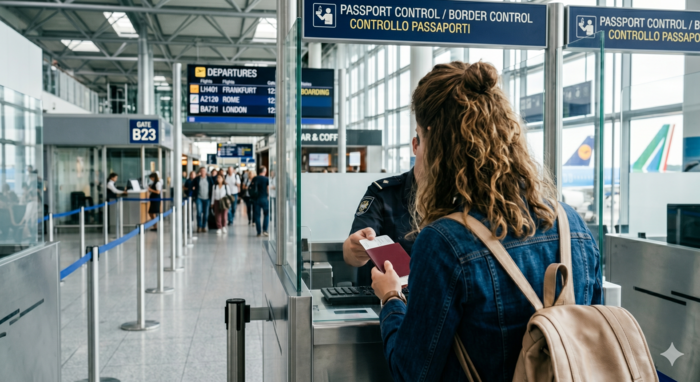
Planning a trip to Italy, Spain, France, or elsewhere in Europe? If you are wondering how long before a European flight you should arrive at the airport for short-haul routes like these, the answer is generally two to three hours. That's the same baseline as domestic travel, but with one important complication worth keeping in mind.
Since the UK left the EU, British passport holders are no longer part of the Schengen Area, which means passport checks at the border are now standard.
These can add meaningful time at busier departure airports, and if you're flying from a major hub like London Stansted, queues can build quickly, particularly during peak season. Giving yourself a comfortable buffer here isn't just a precaution; it's genuinely the sensible approach.
That said, not all airports are the same. If you're departing from a smaller regional airport such as Bristol, Edinburgh, or Birmingham, you'll generally find shorter queues and more manageable terminals. Even so, the two- or three-hour recommendation still applies, because security procedures are identical regardless of airport size and an unexpected queue can appear at any time.
How early to arrive for an international (long-haul) flight
id="international"
How early you should arrive at the airport for an international flight? If you are heading to the US, Asia, the Middle East, or Africa, the rule here is straightforward: at least three hours before your departure time, and for some destinations or airlines, even that can feel tight.
Long-haul travel simply involves more steps than a short domestic hop.
Check-in desks for intercontinental flights are typically handling large volumes of checked luggage, which means queues can be considerably longer. Beyond that, there's passport control, potential visa verification, and in many cases, gates that require a long walk or even a transit connection within the terminal itself.
When you should be at the airport before a long-haul flight isn't just about ticking procedural boxes. It's also about arriving at your gate feeling calm rather than frantic, which genuinely matters when you're about to spend ten or more hours in the air.
Factors that can make you need more time
The recommended times above are a reliable baseline, but certain circumstances call for more. It's worth knowing what these are before you set your alarm.
During peak travel periods, including summer holidays, Christmas, Easter, and bank holiday weekends, security queues at major UK airports can double in length. Adding at least 30 to 45 minutes to your usual estimate is a sensible precaution.
Large, multi-terminal airports introduce another layer of complexity: at Heathrow or Gatwick, the time between walking through the entrance and reaching your gate can easily be 20 to 30 minutes before you've even joined a queue, so factor that distance into your planning.
Checked luggage adds time too: joining the bag drop queue can add anywhere from 20 to 40 minutes, particularly at busy times, so if travelling light is an option, it makes a genuine practical difference.
First-time travellers should give themselves extra room, as navigating security trays, liquid rules, and e-gates takes longer when you're learning as you go. Similarly, families with young children should budget at least 30 extra minutes for pushchairs and slower security, and check whether your airline offers priority boarding.
Passengers with reduced mobility should aim to arrive at least three hours before departure, even for domestic flights, and notify their airline at least 48 hours in advance. In the UK, assistance is provided free of charge by law.
And if you're travelling with a group, or with oversized items like a musical instrument or sports equipment, coordination and separate check-in procedures will add time at every stage.
Tips to speed up your time at the airport
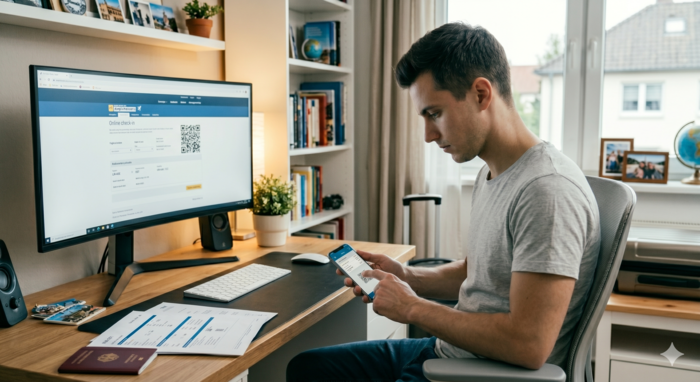
Arriving early is one strategy. Arriving smart is another. There are several practical steps you can take to move through the airport more efficiently, and most of them cost nothing.
The single most effective thing you can do is check in online as soon as the window opens, which for most airlines is 24 hours before departure. Knowing how long before your flight to check in makes a real difference: it confirms your booking, locks in your seat, and means you can go straight to security if you're travelling with hand luggage only, cutting out the desk queue entirely and potentially saving 20 to 40 minutes.
Your airline's app is worth downloading if you haven't already. A digital boarding pass means no queuing at a kiosk or desk. Many airport apps are also worth having, as several UK airports now show live queue times for security and immigration.
If you're travelling during peak season, Fast Track security is worth considering, and some airports also offer twilight or early bag drop, letting you check your luggage the evening before a dawn departure.
Finally, a few small habits make the airport check-in time process quicker for everyone. Have your passport and boarding pass ready before you reach the front of the queue, pack your liquids in a clear bag before you leave home, and if travelling light is possible, combine it with online check-in: the desk queue disappears from the equation entirely.
How soon before a flight should you arrive at Stansted Airport
London Stansted is one of the UK's busiest airports and the primary hub for low-cost carriers including Ryanair, easyJet, and Jet2. If you're flying from there, it pays to know a few specifics rather than applying a generic rule.
For European short-haul flights, arriving two to three hours before departure is the standard recommendation and generally sufficient outside of peak periods. For international routes, you should give yourself three hours.
Get to the airport on time with Flibco
Knowing how early you should arrive at the airport is only part of the picture. The other part is making sure you actually get there reliably, which starts with how you choose to travel.
Flibco runs a direct coach service between central London and Stansted Airport, with departures from Redbridge, Finsbury Park, Liverpool Street, and Stratford.
Buses run every 30 minutes, with schedules built around flight times, so you can plan your journey with confidence rather than hoping for the best. From Redbridge, the journey takes around 30 minutes, making it one of the most straightforward ways to reach the airport from east London.
You can book your seat online in advance, choosing a departure time that gives you the arrival buffer your flight type requires; plus, if your plans shift, there's flexibility built in: Flibco tickets allow you to travel on a later bus using the same ticket, without the need to rebook.
Once you know when to arrive at the airport before your flight, the rest of the planning is simple arithmetic: add your recommended airport arrival time to your Flibco journey time, and you'll know exactly when to leave. No guesswork, no last-minute rush!
FAQ
Do you really need to arrive 2 hours before a flight?
For European and short-haul flights, yes: two hours accounts for check-in, security, and reaching your gate, and it's not a margin worth gambling with.
What happens if I arrive late at the airport?
Missing the check-in cutoff could mean denied boarding in most cases, and most airlines won't offer a refund. Always aim for the recommended window rather than treating the deadline as the target.
Is 1 hour early enough for a domestic flight?
Definitely not, since it leaves almost no margin for error. For instance, an unexpected security queue can quickly turn a tight schedule into a missed flight.
What are the busiest times at the airport?
Early mornings from around 5am and mid-morning tend to be the most congested. Friday evenings, Sunday afternoons, bank holidays, and the start of school holidays also reliably bring longer queues.
How early should you arrive during peak season?
Add at least 30 to 45 minutes to the standard recommended times during summer holidays, Christmas, and Easter. It's not the moment to be cutting it fine.
Can you arrive too early at the airport?
In a sense, yes. Check-in desks typically open two to four hours before departure, so arriving five or six hours early may mean a long wait before you can even drop your bags.
Your flight won't wait, but your planning can
Getting to the airport on time comes down to three things: knowing your flight type, understanding your airline's deadlines, and building in a realistic buffer for the unexpected.
Whether you're figuring out how early to arrive at the airport for a domestic flight or counting down to a long-haul adventure, the same principle applies: plan ahead, give yourself time, and don't treat the minimum as the goal.
Start with your transport. A Flibco coach from central London to Stansted runs every 30 minutes, on a timetable you can count on. Book your seat, work out your timings, and the rest of the journey takes care of itself!